
Welcome to Santiago, Chile , a vibrant city surrounded by the beautiful Andes Mountains. Your journey begins at Arturo Merino Benítez International Airport (SCL), the main gateway to Chile and one of the busiest airports in South America. Designed for comfort and efficiency, the airport connects millions of travelers each year to destinations across Chile and the world, including Patagonia, the Atacama Desert, and Easter Island.
Santiago is served by one main international airport, where all commercial flights operate, making it a key hub linking South America, the South Pacific, and even Antarctica. Understanding the airport layout and connection process helps ensure a smooth and stress-free travel experience, whether you are arriving internationally or connecting to a domestic flight.
For a safe and well-prepared journey, the Santiago Airport (SCL / SCEL) — Route Information Guide helps travelers understand important flight conditions around the Andes. Because the airport is surrounded by mountains, turbulence can sometimes be stronger, seatbelt rules are followed carefully, and special flight procedures are used during arrival and departure. Weather and terrain are always considered, and proper routing over the Andes is essential for a safe and comfortable journey.
Arturo Merino Benítez Airport (SCL) Maps
Navigate the terminals and access routes for Santiago International Airport with our high-resolution visual guides.
Arturo Merino Benítez International Airport
Comprehensive Orientation & Logistics for Chile’s Major Aviation Hub
Official Name and Airport Code
Santiago’s main airport is officially called Arturo Merino Benítez International Airport, a name given in 1980 to honor the founder of both the Chilean Air Force and LATAM, the country’s flagship airline. However, many travelers simply call it Santiago International Airport, and both names refer to the same place.
For travel, the most important code to remember is SCL — this is the three-letter IATA airport code you will see on your boarding pass and baggage tags. The airport also has another code, SCEL, used mainly by pilots and air traffic control for flight planning.
General Information
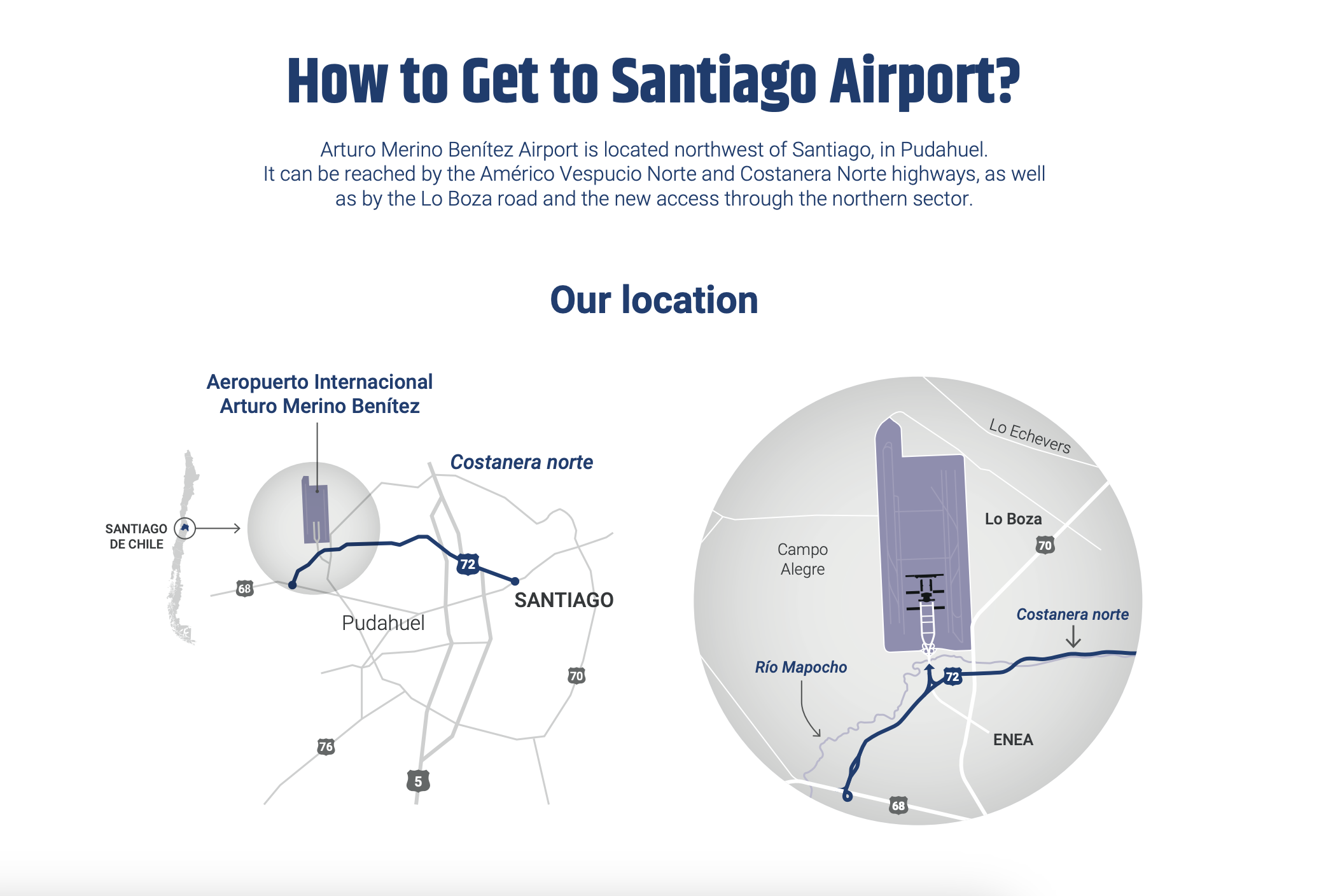
Arturo Merino Benítez International Airport, often called Pudahuel Airport, is the only commercial international airport in Santiago and the busiest in Chile. Located about 17 km northwest of downtown Santiago, it serves as the main hub for LATAM Airlines and Sky Airline, and a focus city for JetSMART. The airport recently expanded, opening a modern new international terminal in 2022 to improve passenger experience and capacity.
Terminals at Santiago Airport
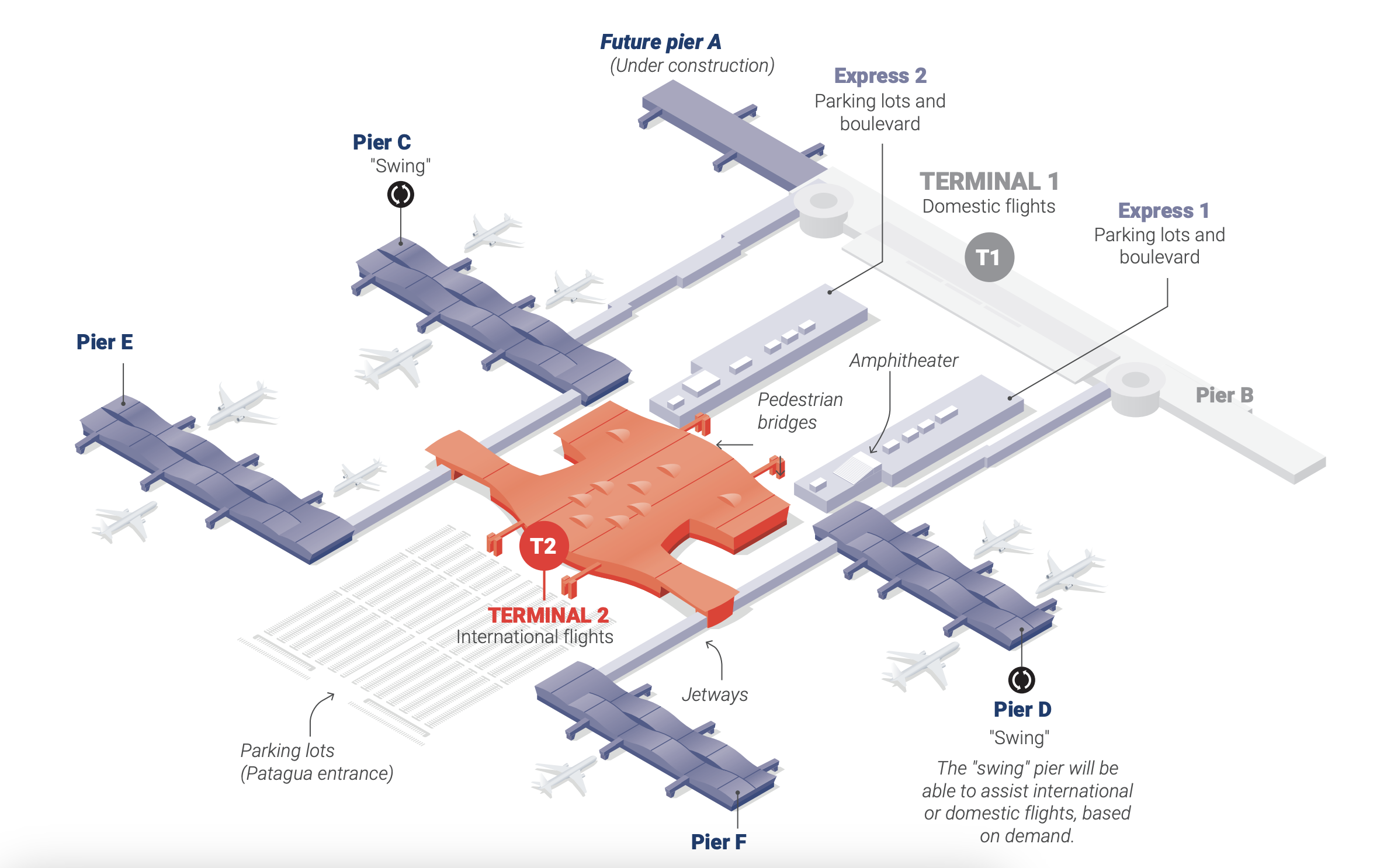
Santiago Airport has two terminals, each serving different types of flights:
Terminal 1 (T1)
Used only for domestic flights operated by LATAM, Sky Airline, and JetSMART.
Terminal 2 (T2)
A modern terminal handling all international arrivals and departures.
Both terminals are connected by a long pedestrian walkway (10–15 minutes walk) and a free shuttle bus.
Getting To and From Santiago Airport
Santiago Airport offers several easy transportation options for travelers:
Centropuerto Bus (Public Shuttle)
This is one of the most affordable and convenient ways to reach the city. The bright green buses run from outside both terminals and travel to Los Héroes Metro Station and Pajaritos Station. The journey takes 30–60 minutes, depending on traffic, and costs around CLP 2,000 (about $2.50 USD). Payment is made in cash on the bus.
TurBus & Pullman Bus
These services operate similarly to Centropuerto and also connect travelers to Santiago’s main bus terminals, making them useful for long-distance travel across Chile.
Official Taxi (Taxi Oficial)
Official airport taxis, easily recognized by their black color with yellow roofs, are available at designated ranks. You must buy a prepaid ticket inside the arrivals hall before leaving. Fares are fixed by zone — for example, a ride to downtown Santiago or Providencia costs around CLP 20,000 ($25 USD).
Transvip and Private Transfers
Private transfer services are available inside the arrivals hall and offer shared or private rides to your hotel for a fixed price. These are often comfortable for groups and sometimes cheaper than taxis for solo travelers.
Ride-Hailing Apps (Uber, Cabify, DiDi)
Ride-hailing services operate legally and are widely used. Pick-up areas are located in the airport parking structure — simply follow signs for “App de Viajes” or “Ridesharing.” These options are often 20–30% cheaper than official taxis.
Car Rental
Car rental companies are available in both terminals. Renting a car is ideal for exploring Chile but is not recommended for driving within Santiago due to heavy traffic and complex roads.
Metro (Future Service)
A metro extension (Line 7) is currently under construction and will connect the airport to the city in the future, but it is not yet operational.
Why Visit Santiago, Chile
When your plane approaches Santiago, the pilot often asks passengers to look outside — and that moment reveals one of the biggest reasons to visit this city: the Andes Mountains. The breathtaking mountain view is part of daily life in Santiago and can be seen from across the city, especially from its famous viewpoints.
Top Scenic Viewpoints
Cerro Santa Lucía
A historic hill offering beautiful city views.
Cerro San Cristóbal
The highest viewpoint in Santiago with panoramic views of the Andes and the city.
Chile is also famous worldwide for its excellent wines. Several wineries are located near Santiago, including Concha y Toro, which can be reached easily using public transport.
If you enjoy coastal landscapes, the Pacific Ocean is only about one hour away, making it easy to take a day trip to:
Coastal Day Trips
Viña del Mar
Known for beautiful Pacific beaches and manicured public gardens.
Valparaíso
Famous for its colorful hillside streets, creative graffiti, and unique cultural charm.
Discover Santiago’s History and Culture
The historic heart of the city is Plaza de Armas, where Santiago was founded in 1541. Surrounded by trees, statues, and historic buildings, the square reflects the city’s rich history.
Key Attractions Near Plaza de Armas
Santiago Metropolitan Cathedral (1748)
A beautiful historic church with detailed architecture.
Central Market of Santiago
Famous for seafood, spices, and traditional Chilean dishes. The most popular specialty here is centolla (king crab).
Museums Worth Visiting
- Displays ancient cultures of Central and South America.
- Three floors of well-preserved artifacts.
- Explains Chile’s wildlife and natural environment.
- Includes exhibits related to Easter Island.
- Highlights: whale skeleton and remains from Cerro El Plomo.
Transportation from Santiago Airport (SCL)
Approximate Travel Time & Cost
Downtown Santiago / Plaza de Armas
- Centropuerto Bus CLP 2,000
- Uber CLP 12,000–18,000
- Official Taxi Around CLP 20,000
Providencia / Las Condes (Hotels & Business Area)
- Transvip Shared Van CLP 9,000 per person
- Uber CLP 15,000–22,000
Ski Resorts (Valle Nevado / Farellones)
Private transfer recommended (4×4 or snow chains may be needed in winter).
Valparaíso / Viña del Mar
Direct bus from Pajaritos Terminal or private transfer recommended.
Practical Tips
Chilean Peso (CLP). ATMs are available in arrivals. Avoid airport exchange counters due to poor rates.
Claro, Movistar, and WOM are available in arrivals. Getting a local SIM is recommended.
Chile has strict biosecurity rules. Always declare food, plant, or animal products to avoid heavy fines.
Excellent options after international security, especially Chilean wine, pisco, and chocolate.
LATAM and other premium lounges are available in both terminals.
Santiago is at about 570 m (1,870 ft). No major altitude concerns for travelers.
Airlines and Flight Operations at Santiago Airport (SCL)
Santiago Airport is one of the most active and well-connected aviation hubs in South America, receiving direct flights from 63 airports across 19 countries, including 17 domestic destinations within Chile. On average, a flight arrives every eight minutes, highlighting the airport’s strong connectivity and constant activity. LATAM is the leading carrier, linking Santiago to 45 destinations, while the busiest domestic routes are Puerto Montt (PMC) and Calama (CJC), together accounting for about 14% of monthly operations. As an important hub for the Oneworld alliance, Santiago Airport plays a key role in global air travel, offering reliable airline networks and wide international connections that make travel to and from Chile smooth, efficient, and convenient for passengers worldwide.
Passengers can easily stay updated about their flights. The official airport website provides real-time arrival and departure information, allowing travelers to check flight status before heading to the airport. This helps you plan better and avoid last-minute surprises.
Airlines Flying to Santiago
Around 19 airlines operate flights to Santiago Airport, connecting the city to multiple international and domestic destinations. Below are some of the key airlines and their codes.
Airline Operator Intelligence
| Airline Name | IATA Code | ICAO Code |
|---|---|---|
| LATAM | LA | LAN |
| Sky Airline | H2 | SKU |
| JetSmart | JA | JAT |
| Aerolineas Argentinas | AR | ARG |
| Iberia | IB | IBE |
| American Airlines | AA | AAL |
| Avianca | AV | AVA |
| Air Labrador | WJ | LAL |
| Air Canada | AC | ACA |
| Copa Airlines | CM | CMP |
| United Airlines | UA | UAL |
| Air France | AF | AFR |
Busiest International Routes
Busiest Domestic Routes
Connecting International to Domestic
Travelers connecting from International → Domestic flights at Santiago Airport must follow these specific steps:
Airport Overview — International to Domestic Connection
Traveling between an international and domestic flight can sometimes feel confusing, especially in a large airport. This simple guide helps you understand exactly what to do after landing at Santiago Airport Terminal 2 (International) to reach Terminal 1 (Domestic) smoothly and without stress.
Santiago Airport has two main terminals.
Terminal 2 (T2) handles all international flights, while Terminal 1 (T1) is used for domestic travel within Chile. Both terminals are connected by walkways and bridges, and moving between them usually takes about 10 minutes. The international terminal is modern and spacious, designed to handle more than 38 million passengers per year.
The airport also includes walkways and bridges connecting both terminals, along with multiple boarding piers (C, D, E, F) used for international departures and arrivals.
Step-by-Step Process for International to Domestic Connection
After your international flight lands:
- Exit the aircraft at Level 2
- Follow airport signs for Domestic Connections
- Listen carefully to crew announcements
- Walk towards immigration and baggage claim area
This step is simple — just keep following the Domestic Connection signs inside the airport.
Next, you must:
- Go downstairs to Level 1
- Pass through Immigration (PDI)
- Show your passport and required travel documents
- Health control may be performed (depending on current rules)
- Continue through Security (AVSEC)
- Complete Customs formalities
- Then move toward the baggage claim area
Only after completing these steps can you continue to the next stage of your connection.
Even if your final destination is domestic, you must collect your baggage at the international terminal first.
- Go to the baggage conveyor belts (after Duty Free)
- Pick up all your luggage
- Continue toward Customs and SAG security arches
- Choose the correct lane: Green lane → Nothing to declare | Red lane → Goods to declare
- SAG inspection, including sniffer dogs, may check restricted items
This is a very important step. Many passengers forget this, but baggage is not automatically transferred for domestic connections. The baggage system is efficient and can process around 1,200 bags per hour, helping keep the process smooth and quick.
After collecting your luggage:
- Walk through the Customs and SAG security arches
- Choose the correct lane: “Nothing to declare” or “Goods to declare” lane
- After crossing the arches, take the first glass door on the left
- Head toward the Domestic Connections counter
Follow the signs carefully to continue your connection smoothly.
Now you must move to Terminal 1 for your domestic flight.
- Follow signs toward Domestic Terminal (T1)
- Walk using pedestrian bridges / walkways
- Travel from Terminal 2 → Terminal 1
- Use walkways at Level 1 (parking area) or 3rd floor
The walk usually takes around 10 minutes. You may need to re-check your baggage at the domestic terminal.
Once you reach Terminal 1 (Domestic):
- Check in and re-drop your baggage at the domestic counter
- Go through domestic security procedures
- Follow airport screens to find your boarding gate
- Proceed to your gate for boarding
Important Tips for Travelers
- Always collect your baggage at the international terminal first
- Keep your passport and documents ready for immigration and customs
- Follow airport signs carefully at every step
- Allow enough time between flights (minimum 2–3 hours recommended)
- The walk between terminals is short, but includes procedures; plan accordingly
Airport Facilities
The airport expansion includes:
- Large parking areas & Bus station
- Shopping and public spaces
- Green areas and walkways
- Exhibition hall and amphitheater
These facilities improve passenger comfort and accessibility.
Airport in Numbers
Large Duty Free and VIP lounge areas are available in both terminals.
Passenger Facilities and Services — Santiago Airport (SCL)
If you have a long layover or overnight stop at Santiago Airport, you will find the airport modern, busy, and comfortable enough to wait between flights. It is not a sightseeing place, but it offers everything you need to eat, rest, stay connected, and relax. Overnight stays are usually allowed if you come prepared.
What You Can Expect at the Airport
Santiago Airport provides useful facilities from check-in to boarding, helping make your journey smooth and comfortable. Inside the airport you will find:
During a Layover or Overnight Stay
If you have a long wait between flights, the airport is workable and practical:
- Food is available both before and after security
- Wi-Fi and charging points help you stay connected
- Seating areas allow you to rest between flights
- Sleeping overnight is generally tolerated if you come prepared
Lounges and Relaxation Options
For a quieter and more comfortable experience, Santiago Airport offers several VIP lounges where you can relax, work, or refresh before your flight. Inside lounges you usually get:
Many lounges are open to all travelers, even economy passengers, by paying at the entrance, buying a lounge pass, or using a membership program.
Major Lounges at Santiago Airport
LATAM VIP Lounge
Primeclass Lounge Andes
Salones VIP Pacific Club (Intl)
Salones VIP Pacific Club (Natl)
Salon Condor
Primeclass Condor Lounge
The Lounge
Quick Tip
If you want a peaceful and comfortable waiting experience, consider entering a lounge. Many lounges allow entry regardless of airline or travel class, and some offer shower facilities to help you refresh during long journeys.
Dining, Shopping, and Amenities — Santiago Airport (SCL)
Santiago Airport offers a wide range of food, shopping, and essential services to make your journey comfortable and convenient. Whether you are arriving, departing, or waiting during a layover, you will find everything you need across both terminals.
The second floor of Terminal 1 has many restaurants and shops, with more options on the third floor. The modern international piers in Terminal 2 also feature new dining and commercial spaces. Along with food and shopping, practical services such as banking, pharmacy, telecom booths, and police assistance are available throughout the airport.
Popular Food Options
Santiago Airport provides useful facilities from check-in to boarding, helping make your journey smooth and comfortable. Inside the airport you will find:
La Cabrería al Paso (after security, Terminal 2)
Cestee
McDonald’s (both terminals), Uncle Fletch burgers, LuluPok poké bowls
Natoo Santiago (plant-friendly café)
Maxi K and small stores in both terminals operate 24 hours for snacks, drinks, and essentials.
24-Hour Food and Drink Locations
Public Hall
- Bakery & Co. (Level 1, Door 1)
- Burger Truck (Level 4, Intl Boarding)
- Cerveceria del Norte (Level 1)
- Dunkin Donuts (Level 3, East Roundabout)
- Gatsby (Rotunda)
- Santa Brasa (Level 3, Door 3)
Domestic Terminal
- Briciole Bar (Level 3)
- Dunkin Donuts (Level 3)
- McDonald’s (Level 2)
- Starbucks (Level 3 / Level 2 Door 28)
International Terminal
- Brioche Dorée (Level 3, West Rotunda)
- Deli & Cia (Gate 17 & Hall E)
- Dunkin Donuts (Level 3)
- Juan Valdez Café (Hall C)
- Patagonia Café (Level 3, Door 16)
- Starbucks (Level 3 near Doors 11 & 19A)
Shopping at Santiago Airport
A strong mix of duty-free and retail stores across both terminals makes it easy to buy essentials and local gifts before departure.
Luggage Storage
Location: Level 1 near Gate 1 (24h)
Small Bag: CLP 7,000 / 24h
Large Bag: CLP 10,000 / 24h
Essential Services
- Bank & ATMs (Banco Santander)
- Telecom booths (Claro, Movistar)
- Pharmacy (Cruz Verde)
- Police (Carabineros de Chile)